Public transit
The Massachusetts Bay Transit Authority received $45 million to offer low-income riders a 50% discount on all fares through the Income-Eligible Reduced Fares (IERF) program. With potential to reach 60,000 riders, the challenge was to design an accessible, user-friendly online application that would remove barriers for vulnerable populations.
Growing up in Lynn, MA (12% poverty rate), I experienced firsthand how transit costs impact mobility choices. This project wasn't just about designing a form—it was about creating economic opportunity for communities like mine.
I designed the complete application flow that earned the Commonwealth Equity in Governance Award, processing 25,500+ applications and helping 60K+ riders save 50% on transit fares.
The Opportunity
The MBTA needed to launch an accessible online application for their new income-eligible fare discount program. The challenge: design something that felt approachable for vulnerable populations while meeting strict government accessibility requirements.
"This is an enormous step for communities of color and communities of low income."
— Noemy Rodriguez, MBTA rider and community advocate
Contributions & Timeline
- Led design of the complete application flow (Nov-Dec 2023)
- Created and tested wireframes through high-fidelity designs
- Coordinated cross-functional collaboration and accessibility compliance
- Official Launch: September 2024
Design Approach
1. Strategic Research & Planning
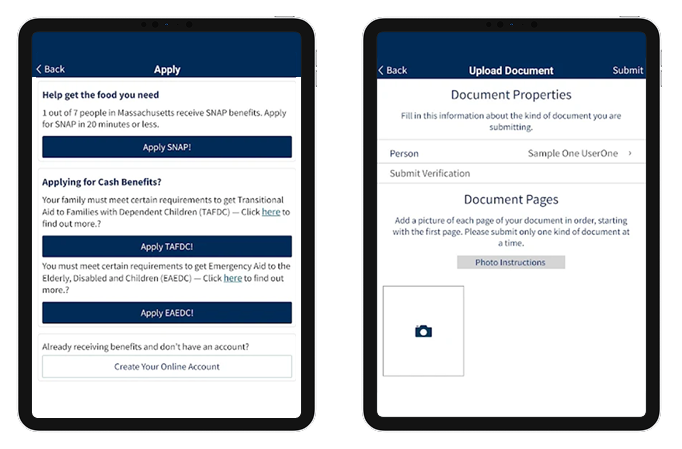
I began by analyzing similar government assistance programs (SNAP and MassHealth) that our target users would already be familiar with. While functional, these systems lacked personality and warmth—an opportunity to differentiate our solution.
Working closely with my cross-functional team, I mapped out the essential requirements:
- Clear eligibility information
- Streamlined document upload process
- Transparent application progress
- Flexible delivery options
- Clear confirmation of approval
2. Collaborative Wireframing
Rather than designing in isolation, I engaged engineers early to understand technical constraints and gather ideas. This collaborative approach led to several key refinements:
- Adding explicit consent for Registry of Motor Vehicles (RMV) record checks
- Offering alternative shipping address options
- Using numeric step indicators instead of percentage complete
The last idea—suggested by an engineer—became one of the most delightful elements of the design. I created a transit-themed progress bar using MBTA's iconic line colors, delivering a moment of delight for our riders.
3. Usability Testing & Iteration
Seven usability tests revealed a critical insight: Users expected to upload proof of benefits.
Our system would verify eligibility automatically by cross-referencing RMV and EOHHS data, but participants assumed they needed to upload documentation. This disconnect could create anxiety and confusion. Working with our content lead, we developed a clear "Before You Begin" page that explicitly stated what users would and wouldn't need, reducing uncertainty and building confidence in the process.
4. Accessibility as Core Design Principle
Knowing that many program participants might have disabilities, accessibility wasn't an afterthought but a foundation of the design:
- Adhered to WCAG AA standards through the MBTA component library
- Conducted comprehensive testing with screen readers
- Partnered with The National Center for Accessible Media (NCAM) for expert audit
- Designed for cognitive, physical, and literacy accessibility needs
"You guys do really, really, really good work here. So be proud of yourselves."
— Claire Houston, Accessibility Specialist at NCAM
5. Thoughtful Handoff & Public Engagement
My handoff process included:
- Complete Figma files with responsive designs
- Detailed documentation of UX considerations and accessibility requirements
- Ongoing support during implementation
I also participated in public comment sessions throughout Boston, where I gained deeper understanding of community concerns and further refined the application based on feedback.
Impact & Learnings
The IERF program has achieved significant adoption since its launch:
This remarkable uptake validates our human-centered design approach and demonstrates the critical need for accessible transit solutions in low-income communities. Each application represents a resident who will save 50% on all transit fares, creating substantial economic relief for thousands of Massachusetts families.
Two Key Learnings
1. Collaboration multiplies creativity.
By bringing engineers into the design process early, we created more innovative solutions like the transit-themed progress bar that brings personality to a government form while improving usability.
2. Empathy requires both listening and action.
Understanding user expectations around documentation allowed us to proactively address concerns before they became barriers, resulting in higher completion rates for the application process.
🏆 Award Recognition
Our team's work on the Income-Eligible Reduced Fares project was recognized with the Commonwealth Equity in Governance Award, which celebrates initiatives that advance equity in government operations. This honor acknowledges how our human-centered approach to designing the application process is helping make transportation more accessible for everyone.